Anatomy of a Tip Screen: Defaults, Service Charges, and the New Arithmetic of Gratuity
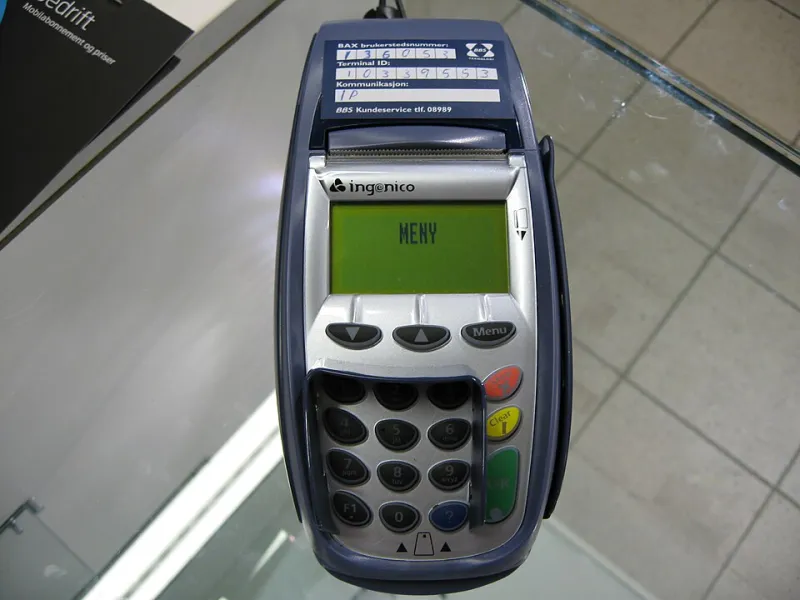
Photo: Michael Shanks, Public domain, via Wikimedia Commons
There was a time when the tip was a decision made after the meal, in private, on a slip of paper that nobody watched you fill out. That moment has largely moved. It now happens in public, on a screen, in front of a person, with three large buttons and a smaller, dimmer option for entering a custom amount. The change is not merely aesthetic. Interface design is a payment product, and the receipt has become a marketing surface.
What the screen is actually doing
A modern point-of-sale terminal does three things at the end of a transaction. It collects payment. It records a line-item breakdown. And it presents a set of choices in a sequence that was configured by someone — a vendor, a merchant, sometimes a franchise template nobody has edited in years.
That configuration is not neutral. It determines which percentage is highlighted, whether the calculation is applied before or after tax, where the custom-amount option appears, and how many taps it takes to decline. None of these are trivial details. Together they form a nudge with a measurable dollar value attached.
Three levers: the default, the anchor, and the frame
The default. Many terminals pre-select one option so that the customer must actively move it. Pre-selection is a strong signal in every consumer interface ever studied, and tipping is no exception. A pre-selected 22 percent is, functionally, a recommendation.
The anchor. Suggested percentages have drifted upward at the same time as the amounts themselves. Where a screen once offered fifteen, eighteen, and twenty, it may now offer twenty, twenty-five, and thirty. The presence of a high option does not force anyone to choose it, but it resets what feels normal, and the middle option tends to capture the undecided.
The frame. This is the most consequential and least understood lever. Suggested percentages are frequently calculated on the post-tax total, which means the customer is invited to tip on the portion of the bill that goes to the state and the city. On a modestly sized check, that quietly inflates the gratuity by several percentage points without anyone deciding to give more.
The service-charge problem
Increasingly, receipts carry a line that looks like a tip but is not one. A service charge, an administrative fee, a kitchen-appreciation charge, or a wellness fee may appear in the total before the tip prompt activates. Whether that money reaches staff depends on the business, the state, and sometimes the week.
Several states require mandatory charges to be disclosed clearly, and federal rules govern how tips and service charges must be treated for tax and wage purposes. But the regulatory picture is patchwork, and much of it focuses on the seller's accounting rather than on the customer's comprehension. A diner who sees a four percent charge on the bill has no reliable way to know whether it substitutes for a tip, supplements wages, or funds the point-of-sale software.
Note also that the federal rule targeting unfair and deceptive fee practices, finalized in late 2024, concentrates on live-event ticketing and short-term lodging. Most restaurant and counter-service charges sit outside its reach.
The counter-service creep
The tip screen migrated from table service to the register, and from the register to the tablet swiveled toward you at a bakery, a coffee bar, a food hall stall, a dry cleaner. In settings where no table service exists and no tip expectation historically applied, the prompt now appears anyway.
This is where arithmetic gets uncomfortable. A dollar on a six-dollar coffee is roughly seventeen percent, and it is easy to tap without registering the proportion. Repeated daily, across several small purchases a week, the amount stops being trivial. Households that audit annual subscription costs rarely apply the same scrutiny to a prompt they see forty times a month.
Why the tip is now a line item in a payment strategy
The practical consequence is that gratuity has become a budget category most people do not budget for. It is variable, it is prompted, and it is presented at the moment of least deliberation — the end of a transaction, often in a hurry, often with a line behind you.
There are two ways to manage this. The first is to decide in advance what you tip in each setting: full service, counter service, delivery, rideshare, and the small extras that do not belong in any of those buckets. The second is to treat the screen as a form to be completed rather than a question to be answered. Read the suggested percentage. Check whether it is calculated on the pre-tax or post-tax amount. Identify any service charge that has already been added. Then choose.
A five-step receipt audit
- Confirm whether the gratuity has already been included, particularly for parties of six or more and for catered or delivery orders.
- Distinguish between a tip line and a service charge line. If it is unclear, ask; a business that cannot explain its own fee is telling you something.
- Check the math. Calculate the gratuity on the pre-tax subtotal if that matches your intent.
- Look for a custom-amount option before defaulting to a preset. It is usually one tap further away than it should be.
- Review the emailed or printed receipt later. Terminal screens are configured for speed; the receipt record is what you actually agreed to.
The bottom line
Most people working behind a tip screen are not the ones designing it. The percentage sequence, the pre-selected button, and the calculation base were chosen somewhere upstream, often to lift average gratuity rather than to reward service more fairly. Recognizing a payment-product nudge for what it is does not require tipping less. It requires tipping deliberately — and knowing, for once, exactly what the number on the screen represents.
ITOnlinePay covers payment interfaces, transaction costs, and consumer spending strategy as part of its ongoing digital payments coverage.