Get Paid Today, Pay for It Tomorrow: The Hidden Arithmetic of Earned Wage Access
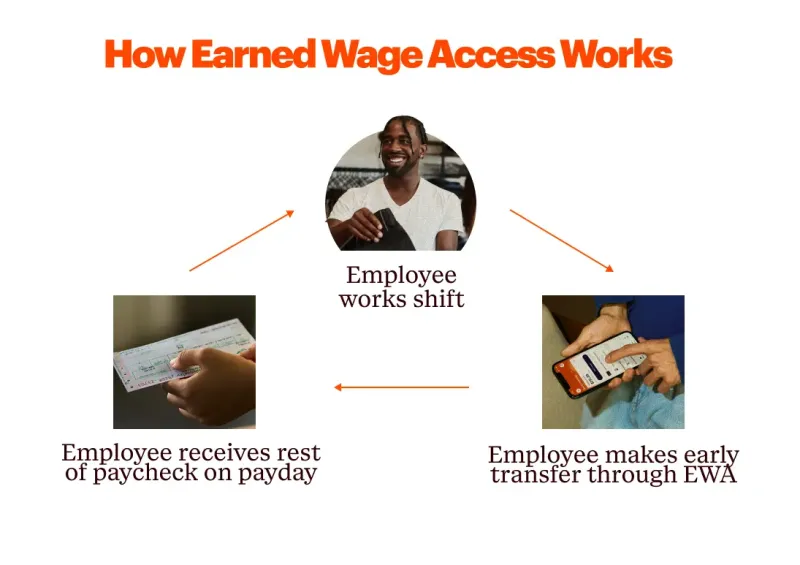
Photo: earned wage access paycheck advance mobile app fintech worker, via www.dailypay.com
For the roughly 78% of American workers who live paycheck to paycheck—a figure cited consistently in Federal Reserve surveys on household financial resilience—a two-week wait between payday and an unexpected car repair is not an inconvenience. It is a financial crisis. Into that gap has stepped a growing category of fintech services operating under the banner of earned wage access (EWA): platforms that allow employees to draw down wages they have already accrued before their scheduled payday.
The pitch is compelling. Apps like DailyPay, Branch, Payactiv, and Rain have attracted millions of users across retail, healthcare, logistics, and gig work sectors. Employers have embraced them as a zero-cost recruitment and retention tool. And at first glance, the model appears fundamentally different from the payday loan industry it is frequently compared to—users are accessing money they have already earned, not borrowing against future income.
But the financial mechanics deserve a more rigorous examination than the marketing materials typically provide.
How Earned Wage Access Actually Works
EWA platforms integrate with an employer's payroll system to track hours worked and calculate wages accrued in real time. Workers can then request a portion of those earned wages—typically between 50% and 100% of what they have accrued to date—delivered instantly to a bank account, prepaid debit card, or the platform's own digital wallet.
On the scheduled payday, the advanced amount is automatically deducted from the employee's paycheck before the remainder is deposited.
There are two primary delivery models in the market. Employer-sponsored programs, such as those offered through Payactiv or DailyPay, are integrated directly into a company's HR infrastructure. The employer typically absorbs the platform cost, and employees access a fixed number of transfers per pay period, often at no charge or for a nominal flat fee.
Consumer-facing apps—including Dave, Earnin, and Brigit—operate independently of employers and connect directly to a user's bank account to estimate income patterns. These platforms tend to rely on optional "tips," subscription fees, or expedited delivery charges to generate revenue.
Dissecting the Fee Structure
The distinction between employer-sponsored and consumer-facing EWA is significant, because the cost profiles diverge sharply.
On employer-integrated platforms, fees are often minimal or nonexistent for the employee. A standard transfer might cost $1.99 to $3.99 for instant delivery, with free options available if the worker can wait one to three business days. In this model, the cost structure genuinely resembles a payroll timing adjustment more than a lending product.
Consumer-facing apps present a more complicated picture. Earnin, for instance, encourages users to leave a voluntary tip—framed as a way to support the service—but research from the Center for Responsible Lending found that tipping behavior frequently translates into effective annual percentage rates (APRs) that rival or exceed those of traditional payday loans. A $5 tip on a $100 advance repaid in two weeks equates to an APR of approximately 130%.
Subscription-based models add another layer. Brigit charges $9.99 per month for access to its advance feature. For a user who draws one $100 advance per month, the effective cost of that liquidity is nearly 10%—before any consideration of expedited transfer fees.
Many platforms also charge $1.99 to $5.99 for instant delivery to a debit card, with free transfers restricted to ACH processing windows of one to three days. For workers facing urgent expenses, the free option is functionally inaccessible, meaning the fee becomes effectively mandatory.
The Behavioral and Cyclical Risk
Beyond the arithmetic, behavioral economists and consumer advocates have raised concerns about the cyclical nature of EWA usage. Because advances are deducted from the next paycheck, frequent users effectively receive a permanently smaller paycheck—which may increase the likelihood of needing another advance in the following pay period.
Data from several platforms suggests that a meaningful segment of users access advances multiple times per month and maintain consistent usage over extended periods. This pattern mirrors the debt trap dynamic documented extensively in payday loan research, even if the underlying product is technically structured differently.
For gig workers and hourly employees—the populations EWA platforms most actively target—income volatility is already elevated. A week of reduced hours, a missed shift, or an irregular tip cycle can compress the earnings base from which an advance is drawn, leaving less buffer in the subsequent paycheck than the worker anticipated.
The Employer Calculus
From an employer's perspective, EWA programs have become a meaningful recruitment differentiator, particularly in competitive labor markets for hourly and frontline workers. Companies including Walmart, McDonald's, and Uber have integrated EWA benefits into their compensation packages, citing improvements in employee retention and reduced absenteeism.
The financial exposure for employers is generally limited. Most employer-integrated EWA providers assume the liquidity risk themselves, advancing funds from their own capital and recovering them at payroll processing rather than exposing the employer to advance defaults. However, payroll integration complexity, compliance obligations under state wage payment laws, and the administrative burden of managing EWA alongside traditional direct deposit infrastructure represent genuine operational considerations.
Several states—including California, Nevada, and Connecticut—have moved to regulate EWA programs, with some requiring licensing or imposing fee caps. The Consumer Financial Protection Bureau (CFPB) has also signaled ongoing interest in whether certain EWA products should be classified as credit under the Truth in Lending Act, a determination that would impose disclosure requirements and rate caps on many consumer-facing platforms.
Innovation or Iteration?
The honest answer is that earned wage access occupies an ambiguous position on the fintech spectrum. Employer-sponsored programs with transparent, low-cost structures represent a legitimate improvement over the bi-weekly pay cycle—a holdover from an era of paper payroll processing that no longer reflects the real-time capabilities of modern payment infrastructure.
Consumer-facing apps with opaque tip models, mandatory subscription fees, and expedited delivery charges are a more complicated proposition. They address a genuine need, but the cost structure for frequent users can accumulate in ways that are difficult to reconcile with the language of financial empowerment.
For American workers evaluating these services, the key questions are straightforward: What is the total cost of each advance, including all fees and tips? How frequently am I using the service, and is that frequency increasing? And critically—is EWA solving a cash flow problem, or delaying a budgeting conversation that needs to happen?
Smart payment decisions extend beyond the transaction itself. Understanding the full cost of accessing your own money—on your own timeline—is where that process begins.