Paying on Your Schedule Now Comes With a Price Tag
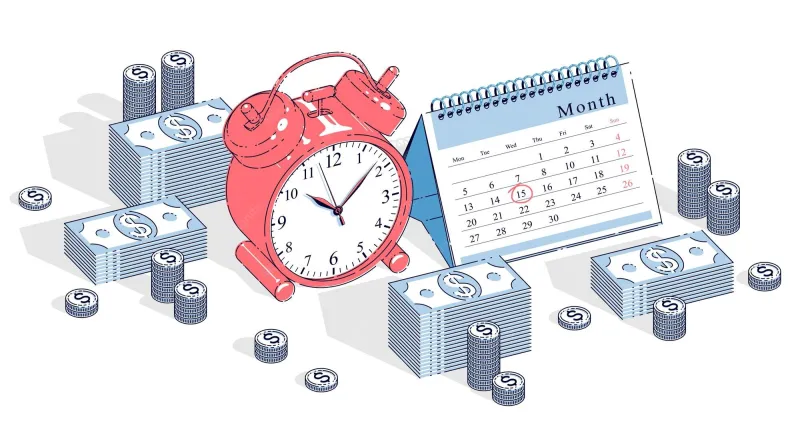
Photo: clock calendar money payment deadline digital finance, via img.freepik.com
For most of the twentieth century, the concept of when you paid a bill was governed by simple, predictable rules. Your mortgage was due on the first. Your credit card statement closed on a fixed date. You had a grace period. These were not luxuries—they were structural features of consumer finance, baked into the product itself.
That architecture is eroding. Across digital payment platforms, fintech apps, and even traditional banks expanding into app-based services, the flexibility to pay early, pay late, or pay in installments has been repackaged as a premium offering. In 2024, timing your payments strategically is increasingly something you pay for—or go without.
From Standard Feature to Subscription Perk
The shift has been gradual enough that many consumers haven't noticed it happening. Early payment discounts on invoices and vendor accounts—once a common B2B arrangement and occasionally extended to retail customers—are now frequently restricted to users on paid membership tiers on platforms like Bill.com, certain QuickBooks configurations, and a growing roster of embedded finance tools.
On the consumer side, the dynamic is equally pronounced. Several buy now, pay later (BNPL) providers that initially marketed zero-fee installment plans have introduced "payment flexibility" upgrades. These allow users to reschedule a due date, skip a payment cycle, or extend a repayment period—for a flat fee or through a monthly subscription. Klarna, Afterpay, and their competitors have each, at various points, introduced features that monetize what used to be handled with a quick phone call to customer service at no charge.
The message embedded in these product designs is not subtle: if you want to control the timing of your own money, you should expect to pay for that control.
The Anatomy of a Timing Fee
To understand how this plays out in practice, consider a mid-income American household managing multiple recurring payments—utilities, streaming services, a car loan, and a BNPL balance from a recent appliance purchase. Each of these creditors or platforms operates on a slightly different billing cycle.
If that household experiences a cash flow gap—say, a paycheck arrives three days after a due date—the options available to them depend heavily on which services they use and whether they have paid for flexibility in advance.
- Utility companies in many states now offer budget billing or due-date adjustment programs, but enrollment often requires a credit check or a deposit.
- BNPL platforms may allow one free reschedule per year, with subsequent changes costing anywhere from $1.99 to $7.99 per adjustment.
- Digital wallets and neobanks increasingly offer "pay later" or "float" features—effectively short-term credit—that are either locked behind premium tiers or carry implicit costs through interest or expedited transfer fees.
For households with strong credit profiles and disposable income, these fees are minor annoyances. For households living closer to the margin, the inability to afford timing flexibility can trigger a cascade: a late fee, a credit score dip, a higher interest rate on the next financing application.
Early Payment: No Longer Its Own Reward
The other end of the timing spectrum presents its own complications. Early payment discounts—historically a mechanism to incentivize prompt settlement and improve cash flow for vendors—have become inconsistently available to ordinary consumers.
Some platforms do offer early payoff benefits, particularly in the auto loan and personal loan space. However, a notable countertrend has emerged: certain lenders now include prepayment penalties or simply structure loan products so that early payoff provides little to no interest savings. This is particularly common with precomputed interest loans, which front-load interest charges regardless of when the borrower settles the balance.
In the digital payment ecosystem, the irony is pointed. Platforms that charge fees for late flexibility also often charge fees for early access to funds—most visibly in the earned wage access (EWA) sector, where workers pay to retrieve money they have already earned before their scheduled payday. The temporal boundaries of a payment cycle have become, in effect, a monetizable asset owned by the platform rather than the consumer.
Who Bears the Cost of This Fragmentation
The financial inequality embedded in payment timing fees is not incidental—it is structural. Consumers with robust emergency funds, high credit scores, and access to low-cost credit lines can navigate timing mismatches without paying premium fees. They can float a balance on a no-fee credit card, transfer funds instantly via a bank that absorbs the cost, or simply absorb a brief delay without consequence.
Consumers without those buffers face a different calculus entirely. A $3.99 fee to reschedule a BNPL payment may seem trivial in isolation. Multiplied across several platforms and several months, it compounds into a meaningful annual expense—one that wealthier households are not paying.
Research from the Consumer Financial Protection Bureau (CFPB) has consistently documented that lower-income Americans pay disproportionately high fees for basic financial services. Payment timing fees represent a newer expression of that same dynamic, now operating within the sleek interfaces of fintech apps rather than the overdraft columns of a bank statement.
The Regulatory Landscape Remains Unsettled
Federal oversight of payment timing fees is, at best, fragmented. The CFPB has authority over certain credit products and has signaled interest in BNPL regulation, but the precise classification of timing fees—whether they constitute finance charges, service fees, or something else—remains legally ambiguous in many contexts.
State-level consumer protection laws vary significantly. Some states cap late fees or require clear disclosure of rescheduling costs; others have no specific framework that applies to app-based payment flexibility features. Until federal rulemaking catches up with the product innovation cycle, consumers bear the primary responsibility for reading the fine print before enrolling in any platform that touches their payment schedule.
Navigating the New Timing Economy
For US consumers trying to manage payment timing without surrendering unnecessary fees, a few practical considerations apply:
-
Audit your platforms. Identify which payment apps or BNPL services you currently use and determine whether they charge for due-date changes or payment deferrals. This information is typically in the terms of service or the app's help center.
-
Align due dates where possible. Many utility providers, credit card issuers, and subscription services will adjust your billing date upon request—at no cost. Consolidating due dates around your paycheck schedule reduces the need for paid flexibility.
-
Treat BNPL scheduling fees as a cost of borrowing. If you anticipate needing to reschedule a BNPL payment, factor potential fees into your effective APR calculation before committing to the installment plan.
-
Evaluate premium tiers critically. Some platform subscriptions that include payment flexibility features do offer net value—but only if you use those features regularly enough to justify the monthly cost.
The Broader Principle at Stake
Payment timing flexibility was never truly free—it was subsidized, embedded in product structures, or absorbed as a cost of doing business. What has changed is who absorbs that cost and how explicitly it is charged.
As digital payment infrastructure matures, the granularity with which platforms can price individual features increases. Timing is simply one of the more consequential features now being unbundled. For consumers who can afford to pay for that granularity, the result is a more customizable financial experience. For those who cannot, it is one more way the financial system charges more from those who have less.
At ITOnlinePay, we believe that understanding these mechanisms is the first step toward making payment decisions that genuinely serve your financial interests—not the platform's revenue model.